The AI is ready. The demos are impressive. The vendors are confident. And yet — somehow — your voice AI deployment is still sitting at 20% of what you planned six months ago.
This is the most common story in voice AI right now, and almost nobody is saying the quiet part out loud: the technology isn't what's failing. The bridge between the technology and your actual business is.
At PrompTive.tech, we work with B2C service businesses that rely on the phone as their primary sales channel. What we keep seeing, again and again, is that the AI itself performs. It's the connection to your existing phone system, your CRM, your routing logic, your 1-800 number — that's where deployments go quiet.
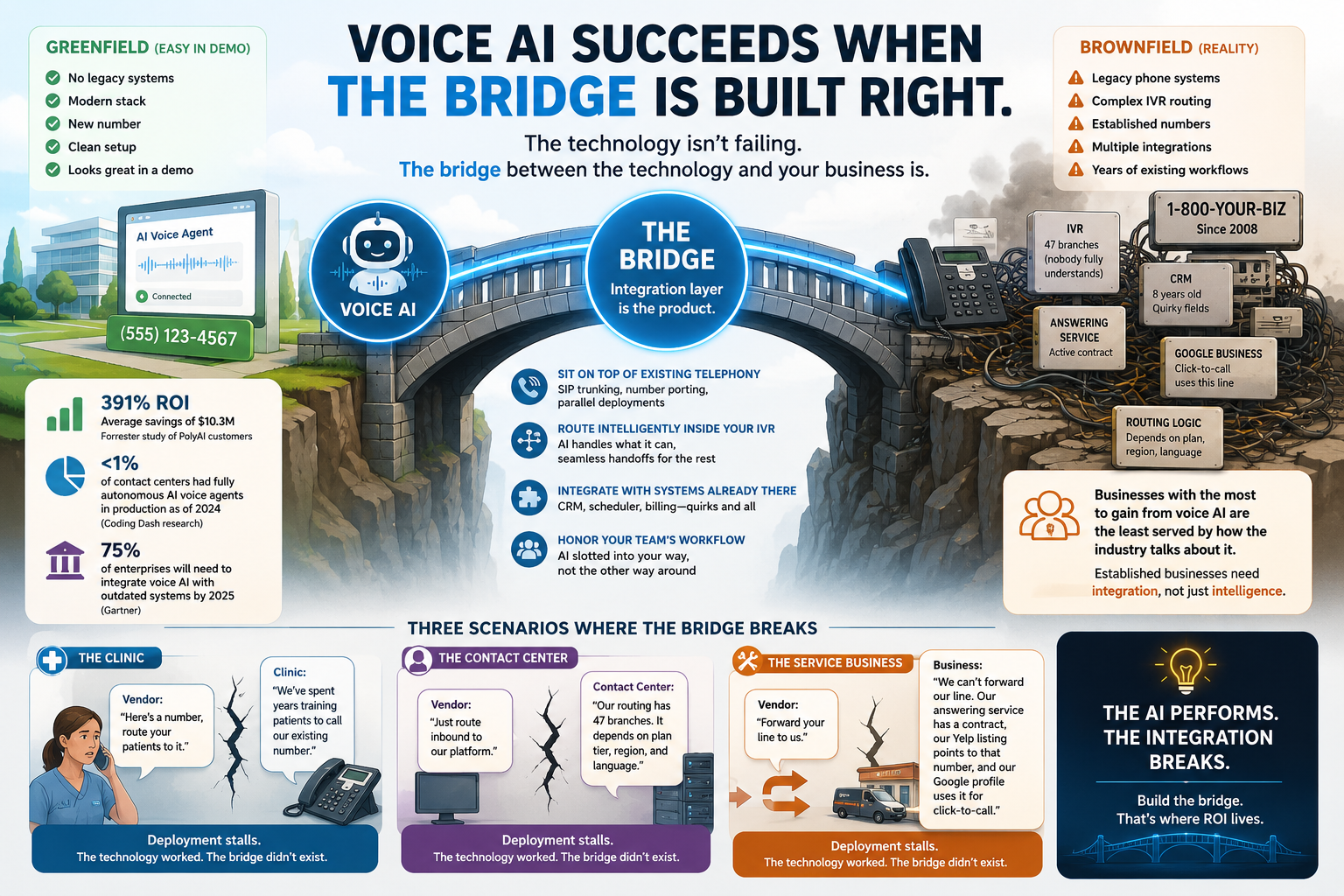
The Market Is Building for Greenfield. Your Business Lives in Brownfield.
The voice AI conversation on LinkedIn, at conferences, and in vendor pitch decks assumes something that isn't true for most businesses: that you're starting fresh.
Greenfield deployment looks great in a demo. No legacy system. Modern stack. You point the AI at a new number and it works. Latency under 500ms. Natural turn-taking. Clean handoffs.
Brownfield is where your business actually lives. You have a phone system built over a decade. An IVR with routing logic that nobody fully understands anymore. A number your customers have been calling since 2008. A CRM with quirky field formatting. An answering service with a contract. A Google Business profile tied to a specific line.
The brownfield is where voice AI has to land — and where most deployments quietly stall, get rolled back, or get reduced to after-hours overflow. Which, ironically, is exactly the wrong place to put expensive new technology.
Why This Problem Is Bigger Than Most Vendors Admit
The numbers tell the story clearly. Despite explosive funding and vendor hype, less than 1% of contact centers had fully autonomous AI voice agents in production entering 2026, according to research from Coding Dash — a stark contrast to the market narrative of widespread adoption. The gap between what's being demoed and what's actually running in production remains wide.
Gartner found that 75% of enterprises need to integrate voice AI with outdated legacy systems — and in 2026, most of those integrations are still unfinished. That integration work is the hard part — not the AI model, not the voice quality, not the latency.
Meanwhile, the ROI when integration is done properly is real. A Forrester study of PolyAI customers found 391% ROI with average savings of $10.3 million. Businesses that get voice AI right achieve a 3-to-1 return on every dollar spent. The math works. The implementation usually doesn't.
Three Deployment Scenarios Where the Bridge Breaks
These aren't hypothetical. These are the patterns that repeat across industries:
The Clinic. A healthcare practice wants AI for patient intake. The vendor says: "Here's a number, route your patients to it." The clinic says: "We've spent years training patients to call our existing number. We can't change that." Deployment stalls. The technology worked. The bridge didn't exist.
The Contact Center. A multi-location business wants AI for tier-1 support. The vendor says: "Just route inbound to our platform." The contact center says: "Our routing has 47 branches. It depends on plan tier, region, and language. It integrates with three internal systems." Deployment stalls.
The Service Business. An HVAC or solar company wants AI for after-hours booking. The vendor says: "Forward your line to us." The business says: "We can't forward our line. Our answering service has a contract, our Yelp listing points to that number, and our Google Business profile uses it for click-to-call." Deployment stalls.
The pattern is identical every time. The AI performs. The integration breaks.
What "The Bridge" Actually Means in Practice
The businesses successfully deploying voice AI right now are the ones treating the integration layer as the product — not the AI model, not the voice quality, not the latency numbers.
Building the bridge means several specific things:
- Sitting on top of existing telephony, not replacing it. SIP trunking that doesn't disrupt service. Number porting that preserves call history. Parallel deployments that let you test the AI against your current system before committing.
- Routing intelligently inside your existing IVR, not around it. The AI takes the calls it can handle and hands off everything else cleanly. The customer never knows there was a transition.
- Integrating with the systems already there. Your eight-year-old CRM. Your scheduler with the quirky API. Your billing system with the specific transaction format it demands.
- Honoring the workflow your team built. Not "adopt our way." More: "here's AI slotted into your way, doing what it's actually good at."
This is less exciting than a speech-to-speech demo. It's also what separates a deployment that delivers ROI from one that gets quietly rolled back to a pilot.
The Businesses That Need Voice AI Most Are the Least Served by How the Industry Talks About It
Here's the painful irony: the businesses with the most to gain from voice AI — established service companies with real customer bases, real phone histories, real existing workflows — are the ones the current market conversation least addresses.
Research tracking voice AI adoption in 2026 found that 47% of businesses first adopted AI voice for after-hours call handling. That's typically not a strategic choice — it's the path of least resistance. After-hours is the one window where you can test AI without touching your existing system. But it's also where you'll see the least impact, because after-hours overflow isn't where your highest-value calls land.
The businesses getting real results are the ones that went through the harder work of full integration. An AI voice agent that can't look up account data, confirm bookings, or initiate backend actions delivers only marginally better results than a basic IVR. The difference between 15% call deflection and 45% call deflection is almost entirely about integration depth — not AI quality.
What to Look for Before You Sign a Voice AI Contract
If you're a business evaluating voice AI, here are the questions that actually matter — not the ones most vendors want you to ask:
- Can your AI sit alongside my existing phone number, or do I have to change it?
- How do you handle integration with a CRM that has non-standard field formats?
- Can I run your AI in parallel with my current system before I commit?
- What happens when the AI can't resolve a call — what does the handoff look like?
- Have you deployed in a business with existing IVR routing logic? Show me that case study.
The vendors who answer these questions specifically and confidently are the ones building for real deployment — not just demos.
The AI Is Solved. The Bridge Is the Work.
Voice AI capability has crossed a real threshold. The conversational AI market hit $17.97 billion in 2026 and is growing at 23% annually. AI voice agents now cost $0.03–0.04 per minute versus $0.70 for a human agent — a 95% cost reduction that has shifted voice AI from an ROI debate to a mathematical inevitability for call-heavy businesses. The technology exists. The economics work. The implementation is where it breaks.
But none of that matters if your deployment stalls at the integration layer.
The businesses that win with voice AI through 2026 and into 2027 won't be the ones that found the most sophisticated AI. They'll be the ones that built — or partnered with someone who built — the bridge between what AI can do and how their business actually operates.
If you're running a service business where the phone is your primary sales channel, the missed-call problem is leaking real revenue right now. The question isn't whether voice AI can solve it. The question is whether your implementation will actually connect to your existing system in a way that makes it work.
If your business runs on the phone, the missed-call problem is costing you real revenue right now — and a demo won't tell you whether voice AI will actually connect to your existing system.