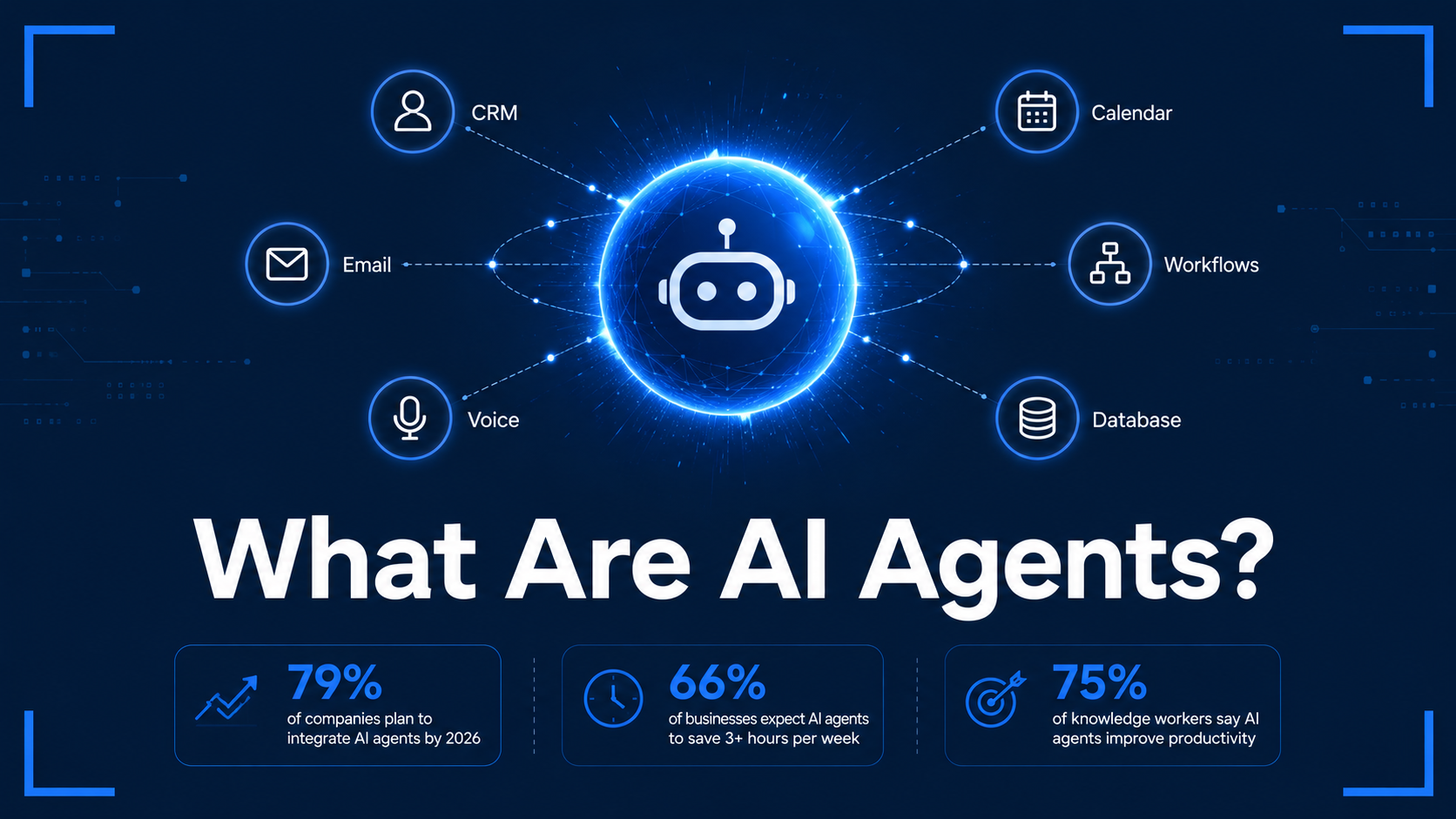
A few years ago, "AI" meant a chatbot that answered your FAQ questions and occasionally gave you the wrong answer. Today, the conversation has shifted entirely. The technology making headlines in boardrooms, at industry conferences, and across the business press is something different: AI agents — autonomous software systems that don't just answer questions, they take action.
If you've been hearing the term but aren't quite sure what it means, or how it's different from the AI tools you've already seen, this guide breaks it down clearly — no jargon, no hype, just what you actually need to know.
What Is an AI Agent, Exactly?
An AI agent is a software program that can perceive a situation, reason through it, make decisions, and take a sequence of actions — all with minimal human involvement. That last part is what makes agents different from earlier AI tools.
A standard AI chatbot waits for you to ask it something, gives you an answer, and stops. An AI agent can be given a goal — say, "follow up with all leads who didn't respond this week" — and then go figure out how to do it. It might check your CRM, draft personalised emails, send them via your email platform, and log the results, all without you lifting a finger.
MIT Sloan professor Sinan Aral, one of the leading researchers on this topic, describes agentic AI as systems that are "semi- or fully autonomous and able to perceive, reason, and act on their own." He adds that the technology "integrates with other software systems to complete tasks independently or with minimal human supervision." In short: these aren't assistants you talk to. They're workers you deploy.
How Do AI Agents Actually Work?
Under the hood, AI agents are built on large language models — the same kind of AI that powers tools like ChatGPT or Claude — but enhanced with several critical capabilities:
- Tool use: Agents can connect to external software via APIs. They can read and write to your CRM, send emails, book calendar appointments, query databases, and interact with websites.
- Memory: More advanced agents can retain information across a task or across sessions, so they don't start from scratch every time.
- Planning: Rather than responding to a single prompt, agents can break a goal into steps, figure out the right order, and execute them in sequence.
- Feedback loops: Agents can check whether an action worked and adjust their approach if it didn't.
A practical example: imagine a small business owner who wants to follow up on every quote sent in the last 14 days. An AI agent could pull the list from the CRM, check which ones haven't had a response, draft a personalised follow-up for each, send them, and update the CRM records — in the time it takes a human to make a coffee.
This is exactly the kind of work that PrompTive builds for its clients — AI voice assistants and workflow automations that handle repetitive, time-consuming tasks so teams can focus on the work that actually requires human judgment.
How Widespread Is This, Really?
The adoption numbers are striking. A May 2025 survey by PwC of 300 US senior executives found that 79% of companies are already adopting AI agents. Of those, 66% report measurable productivity gains, 57% report cost savings, and 55% report faster decision-making.
Perhaps more telling: 75% of those surveyed agree that AI agents will reshape the workplace more than the internet did.
An MIT Sloan and Boston Consulting Group survey from the same period found that 35% of organisations had already adopted AI agents by 2023, with another 44% actively planning to. Leading software platforms — Microsoft, Salesforce, Google, IBM — have all embedded agentic capabilities directly into their products, meaning many businesses are already using agents without necessarily calling them that.
Where Businesses Are Seeing Real Results
According to PwC's research, the business functions seeing the most active AI agent deployment right now are:
- Customer service and support — 57% of companies are using or actively planning agents here
- Sales and marketing — 54%
- IT and cybersecurity — 53%
One retail company PwC highlighted started by using agents to cut software development cycle times and reduce production errors by more than half. From there, they expanded into HR, finance, supply chain, and marketing. That pattern — start with one high-value use case, then expand — is consistent with what the most successful adopters are doing.
For smaller and mid-size businesses, the entry points tend to be more immediate: handling inbound calls around the clock, following up on leads automatically, routing customer enquiries without a human dispatcher, or keeping CRM records updated in real time. These aren't glamorous use cases, but they're the ones that free up 20 to 30 hours per week that teams currently spend on work a machine can do better and faster.
What AI Agents Cannot Do (Yet)
It's worth being honest about the limitations, because a lot of the coverage around AI agents swings between dismissal and breathless excitement, and neither is useful.
MIT Sloan's Kate Kellogg, whose research involves implementing AI agents in real organisations, found that when her team deployed an agent in a healthcare setting, 80% of the actual work was not the AI itself — it was data engineering, stakeholder alignment, governance, and integration. The agent worked well once everything was set up properly, but getting to that point required significant groundwork.
MIT Sloan's Sinan Aral also notes that agents "can struggle with tasks that humans typically do easily," particularly handling exceptions and edge cases. An agent trained to follow a process will follow it — even when the situation calls for a human to recognise that the normal process doesn't apply.
This is why thoughtful implementation matters more than the technology itself. An AI agent is only as good as the workflow it's been given to follow and the data it has access to.
The Risks Worth Understanding
Three risks come up consistently in serious research on AI agents:
Security and data access. AI agents need access to your systems to work. That means they also represent a potential vulnerability. A SailPoint survey found that 80% of organisations have experienced agents acting outside their intended boundaries. Scoping permissions tightly from the start is not optional — it's foundational.
Accountability gaps. When an AI agent makes a mistake — sends the wrong message, updates the wrong record, takes an action based on faulty data — it needs to be clear who is responsible and how to catch and correct it. Kellogg's research recommends treating monitoring as a permanent operational cost, not a one-time setup task.
Governance lag. PwC found that trust in agents drops sharply for high-stakes tasks. Only 20% of executives trust agents to handle financial transactions autonomously, compared to 38% for data analysis. That gap is reasonable — but it means organisations need clear policies for what agents can and cannot do before deployment, not after.
So, Should Your Business Be Using AI Agents?
If your team is spending significant time on repetitive, rule-based tasks — calls, follow-ups, data entry, routing, scheduling — then yes, there is almost certainly a meaningful opportunity here. The question is not whether the technology can do it, but whether you have the right system design, the right data, and the right oversight in place to make it work reliably.
The businesses getting the most value out of AI agents right now are not the ones who moved fastest. They're the ones who were deliberate — who started with a specific, well-defined use case, measured what changed, and expanded from there.
If you want to understand what that could look like for your business specifically, the first step is a conversation about how your current processes actually work.
Book a Free Strategy Call with PrompTive — Find Out Exactly Where AI Agents Fit in Your Business